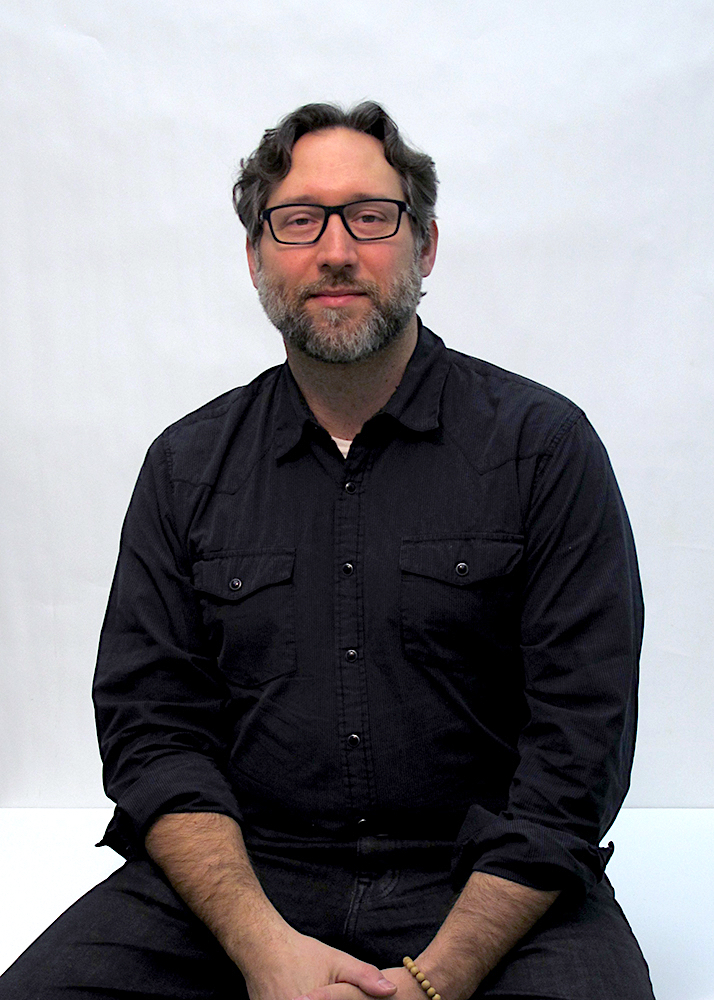
Artist Bio
Nicolas Darcourt was born in Lima, Peru and was raised in Appleton, Wisconsin. Growing up with separated parents and families in different hemispheres of the globe, created a situation of always comparing cultures. Needing to imagine great distances to understand the everyday, and accepting the combination of disparate modalities as commonplace. He realized his connection to clay and the ceramic process at a young age, and can remember a profound aesthetic experience working with the material when he was 10 years old. Regarding his continued relationship with the material and process, Nicolas writes “Clay has the ability to be a very personal, yet permanent material. It can record a finger print, then transform it to something stone like. Ceramics represents a vast number of cultures and civilizations. It is the formless which we have in common, it is a subconscious equalizer.”
Nicolas Darcourt received a Bachelor of Fine Arts from Northern Michigan University, and a Master of Fine Arts from the University of Minnesota, Twin Cities with a Minor in Art History. Upon completion, Nicolas has been a resident artist at the Archie Bray Foundation for the Ceramic Arts. His ceramic work has been shown both nationally and internationally, and belongs to a number of private collections. Nicolas has exhibited work in solo, two person, and group exhibitions in regional venues such as the Hillstrom Museum of Art St. Peter MN, the Minnetonka Center for the Arts MN, The Phipps Center for the Arts Hudson WI, and The Carnegie Art Center Mankato MN. Nicolas has also exhibited works in local and national juried group exhibitions at such venues as the Rosalux Gallery Minneapolis MN, Workhouse Art Center Lorton VA, the LH Horton Jr. Gallery Stockton CA, Mulvane Art Museum Topeka KS, and the Kirkland Arts Center Kirkland WA. Nicolas has received a McKnight Artist Fellowship and a Minnesota State Arts Board, Artist Initiative Grant. He has taught ceramics at Minnesota State University Moorhead and The University of Minnesota, Twin Cities Regis Center for Art. Currently, he is a Continuing Assistant Professor in the Department of Art and Art History at Gustavus Adolphus College. Nicolas, his partner, and son live outside South West Minneapolis, where he has a home studio.
_________________________________________________________________________________________

Artist Statement
Clay, and the ceramic process, allows me to make a permanent record of what filters into my daily experience. A material which is immediately responsive to my fingertips, or to a surface of a mold, lends itself well to capturing and rendering visual information from the world that surrounds me. Through the use of press molds, I can make multiple transfers from real objects, and combine them with simple hand-built shapes. Translating my ideas into clay of warm terra cotta hues speaks of timelessness. A material which is both intimately connected to our humanity and can be made to take any form. As a companion to society, I feel it owns a historicity like almost non-other. And as a result, clay has the ability to express notions of the human condition.
An overt theme in my work is the human condition of our relationship to accumulation. I view the world around me as a landscape of accumulating visual information constructed of sporadic cultural significance; ambiguity defined by brief moments of clarity. I am fascinated by how, as decades pass, both new and old overlap and fold into each other. As I build by way of the accumulation of parts and fragments, the perception of meaning becomes suspended and continually reinterpreted.
My material process combines multiple parts, pieces and fragments into sculptural forms. And by focusing on a mix of architectural ornament, exposed layers of earth, engineered forms, monument, and manufactured byproduct, the accumulations I create reference abstract notions of the confluence of memory, geography, and society. All of the information we see in the present also contains something of the past, the process behind the viewable surface. Both natural and human made, we are surrounded by vast accumulation, fragmentation and deep repetition. My work expresses this viewed reality, not from a place of judgment, but rather a place of investigation and rumination.
 Nicolas Darcourt